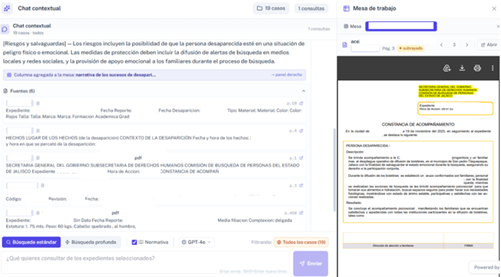
ContextIA is an artificial intelligence tool that extracts, organizes, and classifies key information from investigation files and records. The tool is designed to support investigation processes, such as contextual analysis1 in the search for disappeared persons, ensuring structured, efficient work that complies with current national and international standards.
Large volumes of information
Investigation files and records contain vast amounts of documents and data, making it difficult to locate relevant information quickly and efficiently.
Poor quality of digitalized information
Investigation files and records often include documents with legibility, image quality, or formatting issues, making them difficult to read, consult, and analyze.
For example:
Fragmented and dispersed information
Key information often appears across different documents and formats, which makes it harder to identify connections and patterns.
Prolonged review times
Personnel often review, extract, and systematize information manually, which consumes significant time and limits analytical capacity.
Institutions in charge of investigations face growing demands with limited time and resources. In response to these challenges, ContextIA emerges as an artificial intelligence tool that seeks to strengthen information review and analysis processes within institutions, optimizing review times and facilitating the extraction and organization of relevant information.
Speeds up the review and analysis of information
Enables personnel to process and analyze large volumes of information in a structured and efficient manner.
Facilitates access to relevant information
Locates key information within one or multiple investigation files or records in a matter of seconds.
Extracts and systematizes key data
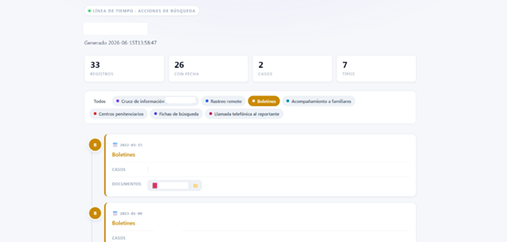
Identifies relevant information, such as names, phone numbers, license plates, and geographic coordinates, facilitating its analysis and organization.
Optimizes document review processesl
Reduces the time required for reading and manual information retrieval through dynamic, automated queries.
Identifies relevant connections and patterns
Identifies connections and relevant patterns across different documents and cases.
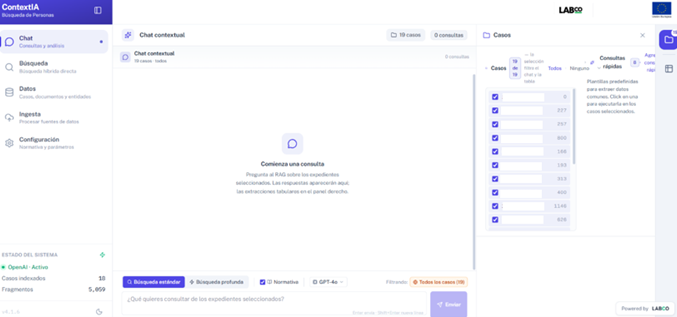
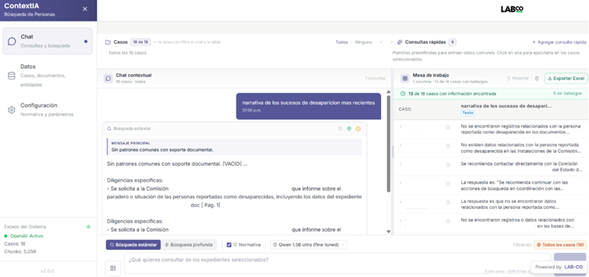
ContextIA features a chat-based interface that allows users to ask questions and request information about the cases loaded into the tool. Unlike other AI-powered chat tools, ContextIA does not generate fabricated responses. It draws its results exclusively from the information contained in the investigation files and records. This enables users to obtain structured results in minutes, based solely on the information available within the tool.
ContextIA adapts to the technical and operational needs of each institution, allowing users to tailor its functions and outputs. Currently, it operates in two main modes:
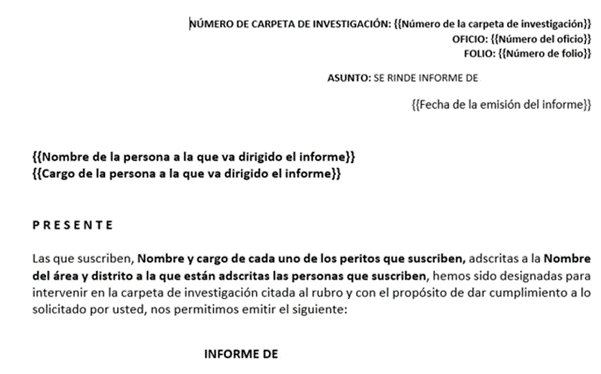
Users can organize information and generate structured documents based on formats that each institution defines in advance. This does not replace the work of public servants but rather saves them time and allows for an expedited and thorough analysis.
ContextIA incorporates security measures and operates under an ethical approach that ensures the responsible protection of information and respect for human dignity:
Controlled institutional environments
The tool processes information exclusively within institutionally approved environments, preventing any external filtration of sensitive data.
Evidence-based queries
The tool draws its results exclusively from the information in the investigation files and records that institutional personnel load into it; it does not fabricate information.
Regulatory compliance
The tool follows national and international methodologies and frameworks for investigation, ensuring compliance with legal and ethical standards.
Complementary tool
ContextIA supports review and analysis processes but does not replace the decision-making of institutional personnel.
ContextIA uses language models, semantic search systems, and artificial intelligence to understand, organize, and connect information across documents and cases in minutes. It also employs OCR (optical character recognition) technology to process digitized documents and scanned files. This allows the tool to identify matches across names, phone numbers, license plates, and locations, even when the information varies in how it is recorded.
ContextIA integrates these technologies into a modular architecture that adapts to different institutional processes and needs and supports the continuous incorporation of new functionalities.
ContextIA supports institutions that review and analyze investigation files and case records. Its use is exclusive to specialized personnel who work in institutional settings and handle sensitive information, such as Criminal Justice System institutions.
To implement ContextIA, institutions must have certain inputs that are already part of their regular workflows:
Digitized investigation files and/or search records in PDF format, as well as other digitized materials, such as text documents, images, videos, or information that institutions store in databases.
Metadata such as the case start date, a unique identifier, and other key information that ContextIA needs to organize and analyze the data properly.
If your institution is interested in learning more about ContextIA and its potential applications for strengthening investigation processes, contact us. We can provide information about the tool, how it works, implementation experiences, and the requirements for its adoption in institutional environments.